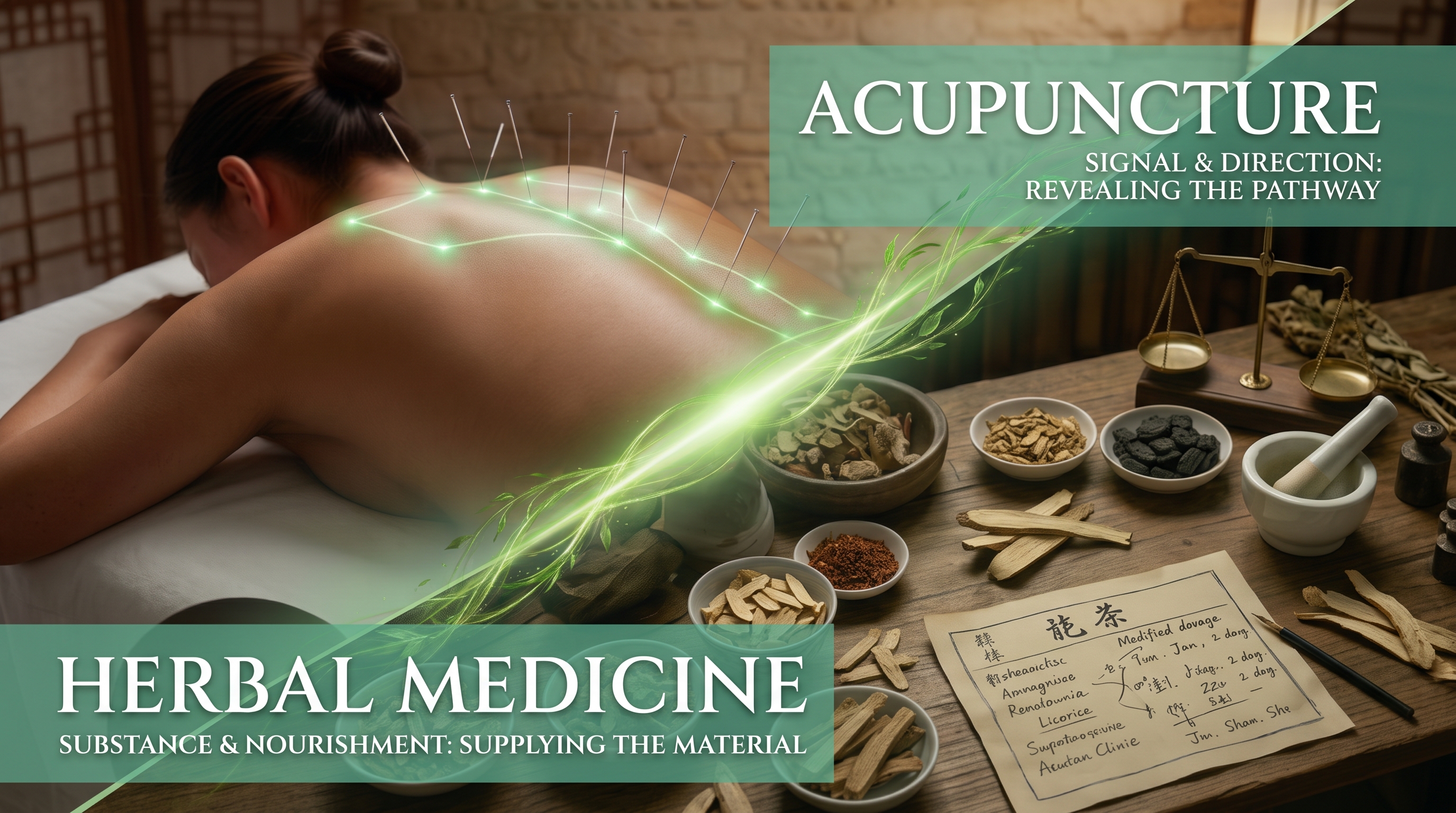
Acupuncture and herbal medicine were never meant to be separate practices.
In the United States, most practitioners work almost exclusively with needles. Herbal training often stops at memorizing a handful of classical formulas — enough to pass an exam, not enough to modify a prescription for the patient sitting in front of you. Others step away from herbs entirely and reach for supplements instead.
The divide starts before anyone sees a patient. Accredited programs award two distinct degrees: a Master of Acupuncture, and a Master of Acupuncture with a Chinese Herbal Medicine specialization. The herbal track isn't a seminar bolted onto the end. Illinois sets the floor at instruction in a minimum of 300 individual herbs — function, identification, contraindications, dosage — plus supervised clinical training in which students interview, diagnose, and write formulas, moving from full supervision to independent formula development.
That training is what carries the authority. Since 2021, the Illinois Acupuncture Practice Act has included herbal medicinals within the licensed scope of acupuncture — but the same Act limits a licensee to practicing consistent with the education and certifications they actually obtained. A practitioner who took the acupuncture-only path can't add herbs later by deciding to. The degree chosen at enrollment sets the boundary of a career. (Scope and requirements vary by state; practitioners should confirm their own board's rules.)
This isn't a licensing gap. Herbal certification is already built into the Master's of Oriental Medicine. The training is there. What's missing is the depth of practice that turns a formula from a fixed recipe into a clinical tool.
There's a structural reason this matters.
The body has an external architecture — bone, muscle, tendon, ligament, connective tissue — and an internal one: the organs and the central nervous system. These aren't separate systems. Blood vessels, peripheral nerves, and the interstitial spaces run between them, carrying signal and substance in both directions.
Acupuncture engages the external structure in two ways. Locally, it treats the site itself — the channels, the musculature, the joint. But it also works through sensory perception: the needle generates afferent signal that travels inward along the peripheral nerves and changes how the nervous system reads the body. This is the soma influencing the psyche, and it's why acupuncture reaches psychosomatic presentations that have no local lesion to treat.
Acupuncture does reach internal conditions — through referred stimulation, and through the way each point affects circulation to the organ its channel serves. But direction alone isn't enough. Physiological change requires material to build from. Herbs supply the substance; acupuncture moves it where it's needed.
This is why the difference shows up most clearly in dermatological, autoimmune, and digestive cases. These are conditions where the body has to rebuild something — tissue, barrier function, regulatory balance — and there is nothing to direct if the material isn't there. Accreditted schools of TCM, such as Chicago College of Oriental Medicine, train both paths. We watch the difference play out in our own teaching clinic. Practitioners who prescribe herbs skillfully — and modify as the case evolves — consistently reach results that acupuncture alone doesn't.
Acupuncture is remarkably effective, for the reasons above. That isn't in question. The point is that a practitioner trained in both isn't choosing between two options. They're treating the whole structure. Acupuncture and herbal medicine developed together. They aren't two treatments that happen to share a tradition — they're two halves of one system, built to do different work on the same body.


